| Field | How it enters the estimate | Your lever |
|---|---|---|
| Followers | Gives the base that every other factor builds on | Gain followers who are real accounts |
| Following | Set against followers, with a heavy cut when you follow over 500 and the ratio tops 0.6 | Drop accounts that never followed you back |
| Account age | Lowers the weight of an account younger than a month | None, only time helps |
| Posts in the last 30 days | Pays for regular posting and docks a quiet month | Spread posts over different days |
| Replies from bigger accounts | Adds weight for ties to established accounts | Keep replying under their posts until your name is familiar |
| Verified, phone number | Two small flat bonuses | Add a phone number to the account |
The result is a score band for your account, not a verdict
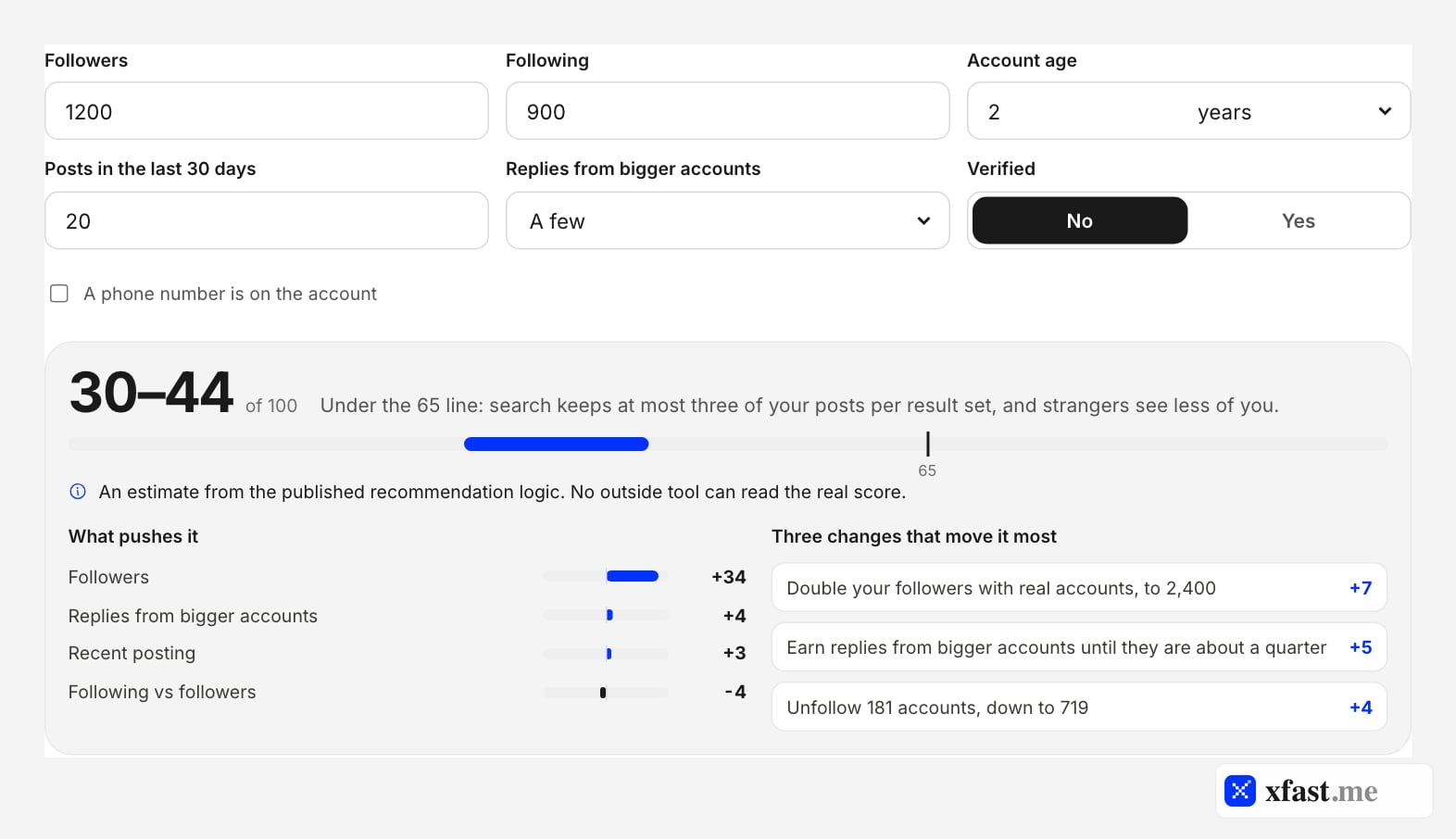
The real score is computed inside X from the whole follow graph, so no outside tool can read it. The calculator rebuilds it from the published recommendation code: the follow ratio rule, the 30-day age discount and the second cut above 2,500 follows are applied as the code states them. Followers stand in for the graph, so the answer is a band such as 38 to 52, never one exact number.
Use the band to compare your account with itself. Change one input, watch the band move, and you know which habit is worth your next hour.
Get your band in three steps
- Open your profile and type in your followers, following, account age and the number of posts you made in the last 30 days.
- Pick how many replies under your posts come from bigger accounts, and mark verified and a registered phone number if they apply.
- Read the band, then the list of pushes, then the three changes. The address updates as you type, so you can copy it and send the filled tool to a friend.
Following over 0.6 times your followers is a cut you can undo today
Once you follow more than 500 accounts and the following-to-followers ratio climbs past 0.6, X divides your base weight. An account with 1,000 followers and 1,000 follows loses about six sevenths of it. The calculator draws this as a negative bar, and when it is the largest gain available, the number of accounts to unfollow leads the list of changes.
With a healthy ratio the bar stays empty and the suggestions move on to followers, replies and posting. Our article on what Tweepcred is explains where each of these rules comes from.
Below 65, a search result carries no more than three of your posts
On the gauge, 65 is the mark past which search no longer limits one author to three posts in a single set of results. Beneath it, people searching a topic meet fewer of your posts, while your followers notice nothing. If your band sits on the line, one change decides the side, so start with the first item of the three.
A young account gives up most of its score to age and recovers it by day 30
During its first month an account's base weight is scaled down by its age: at one day old it keeps roughly 6 percent, at two weeks about two thirds. The days that remain show up among the changes. Fill them with posts and replies instead of mass following, because a long follow list piles the ratio cut onto the age cut.
Followers from established accounts lift the band and empty ones barely move it
The score follows who follows you. Ten followers with photos, posts and audiences of their own help more than a thousand blank accounts, and bought followers are forbidden and give the score nothing to work with. The followers worth having are the real ones, and free followers from real people are that kind. Our follower growth calculator shows how long a target takes, and the engagement rate calculator shows whether the people who already follow you respond.
Change one thing, run it again, keep what worked
Make the first change from the list, wait a few days and type the new numbers in. If the band rose, keep the habit. If it stayed flat, the change was already priced in and the next item is the better use of your time. For ways to find accounts that raise the number, read how to get more followers on X.
 Buy X followers doesn't make sense: you get numbers, not readers, while real followers are free hereBuy X followers? Bought followers are fake accounts that never read a post. Real followers from real people are free at XFast, with no password.
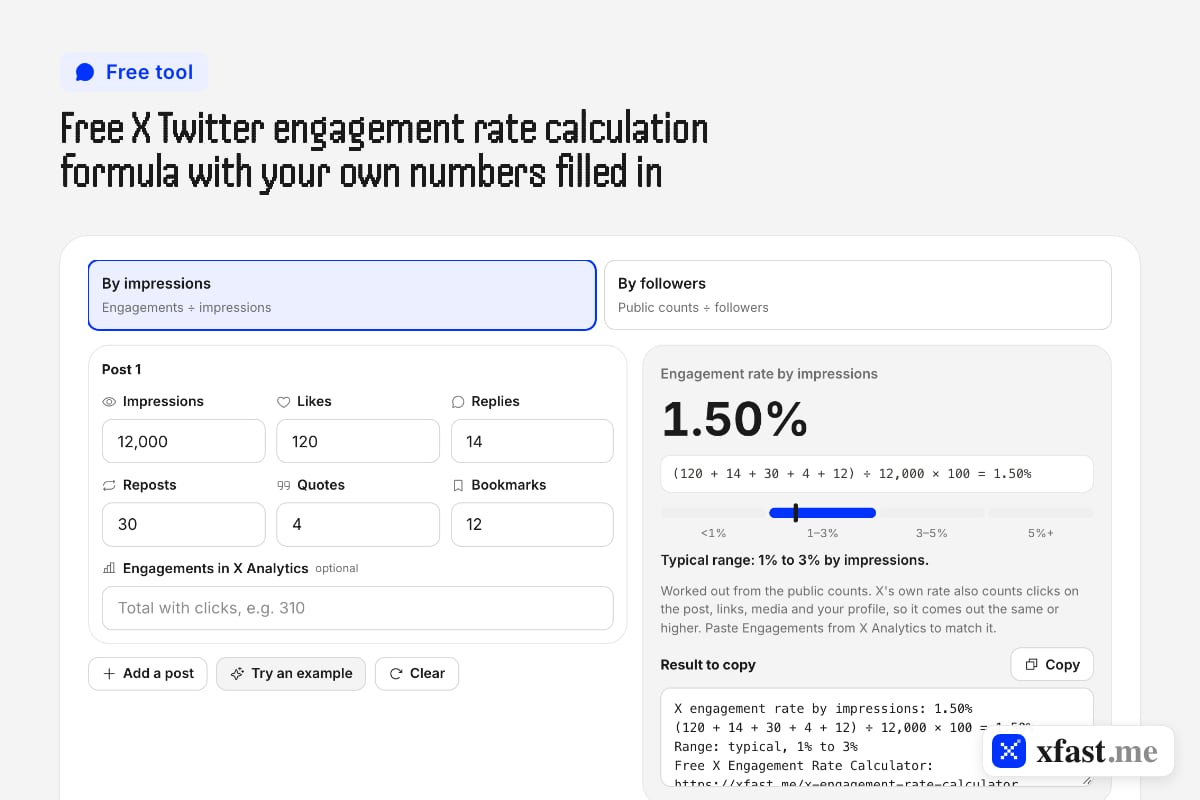 Free X Twitter engagement rate calculation formula with your own numbers filled inFree X Twitter engagement rate calculation formula as a calculator: by impressions or followers, one post or many, with your numbers in the formula.
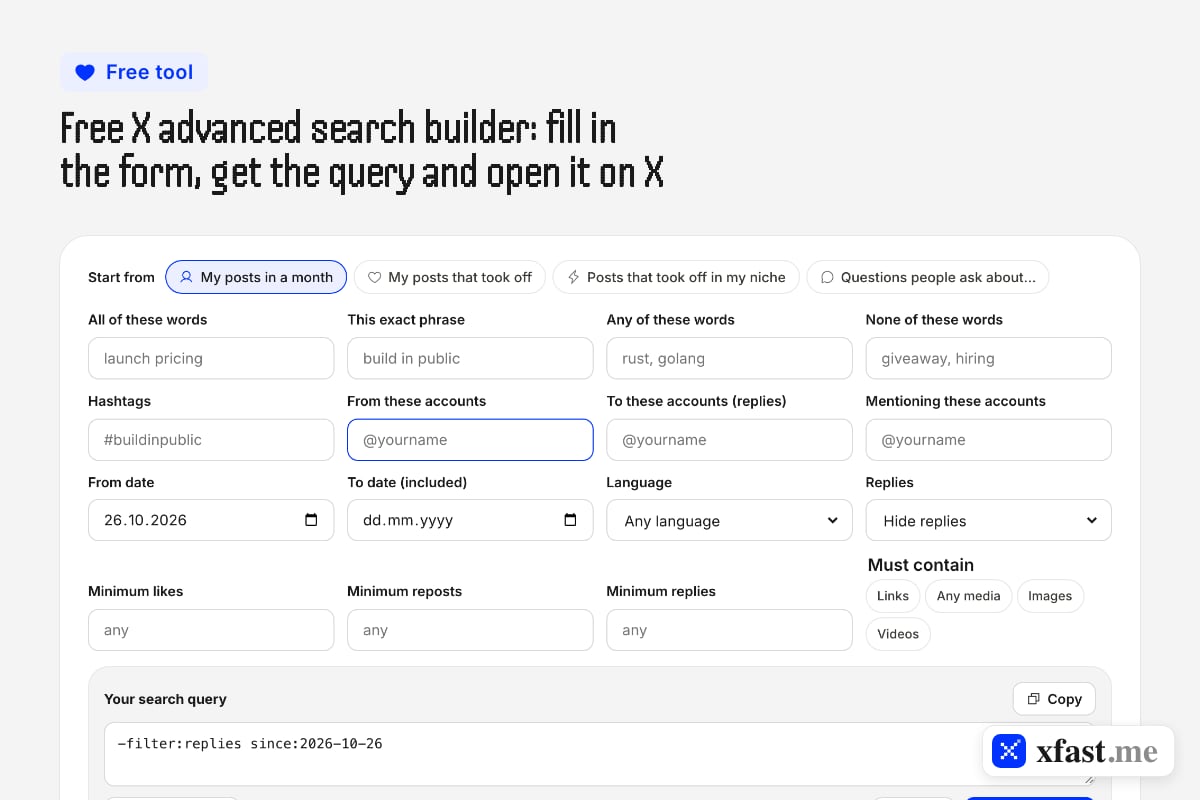 Free X advanced search builder: fill in the form, get the query and open it on XFree X advanced search builder: fill in words, accounts, dates and likes, get the query for X search, copy it or open it in Latest. Presets for your own posts.